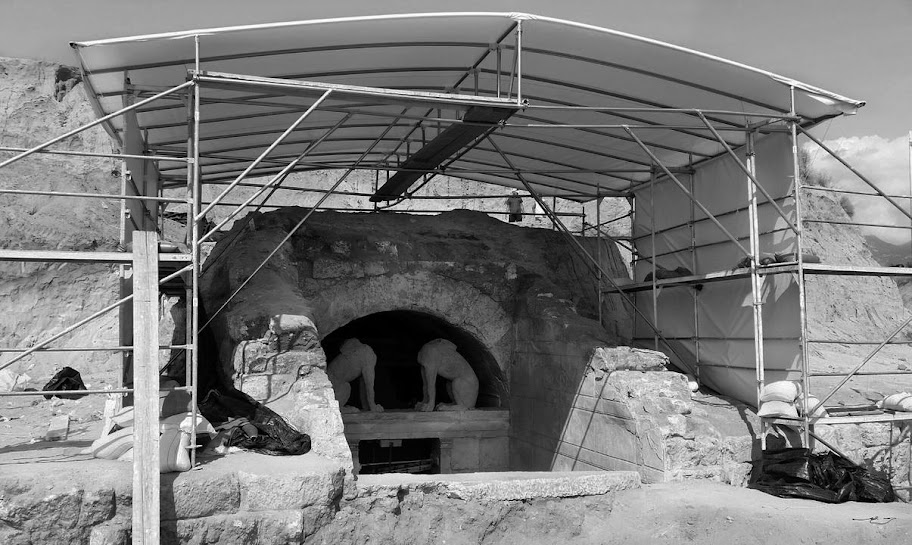
 The first gate is excavated at the Kasta Hill site in Amphipolis Greece. Photo by Greek Culture Ministry via AP.
I. The Largest Tomb In Greece Is Unearthed
The first gate is excavated at the Kasta Hill site in Amphipolis Greece. Photo by Greek Culture Ministry via AP.
I. The Largest Tomb In Greece Is Unearthed
In the summer of 2014, an archeological dig in northeastern Greece unearthed an unprecedentedly massive tomb. The discovery was the culmination of 100 years of dedicated efforts made by a series of determined archeologists working in a country with the distinguished reputation as the birthplace of Western civilization.
What new discovery could rival The Parthenon temple ruins at the Acropolis in Athens or compare to centuries of ancient sculpture? Haven't all of the important ancient sites been uncovered in Greece?
The answer is no. One-hundred years after The Parthenon was finished, an unprecedentedly massive tomb would be built by the followers of Alexander The Great.
The first clues to the location of the tomb came in 1912 in northeast Greece during the Balkan Wars. As the prelude to World War One played out in southeastern Europe against the last of the Ottoman Empire, soldiers stumbled across an abandoned area covered in ruins, carved stone and shattered stone sculpture.
In the 4th Century BC, this area was once an important Macedonian naval base called Amphipolis. Later, it became one of the main stops on the Macedonian royal road as testified by a border stone found between Philippi and Amphipolis giving the distance. After Rome conquered Macedonia in 168 BC, it became the "Via Egnatia" - a principal Roman road which crossed over the southern Balkans. Paul, the disciple of Jesus Of Nazareth, also passed through Amphipolis between 33–36 AD
[0].
After World War One ended, reconstruction of the statue and it's base began. The results were re-assembled in 1937. Given the location that they were found in the results were astounding. These were the remains were of a giant stone lion that measured 17.3 feet/5.3 meters tall.
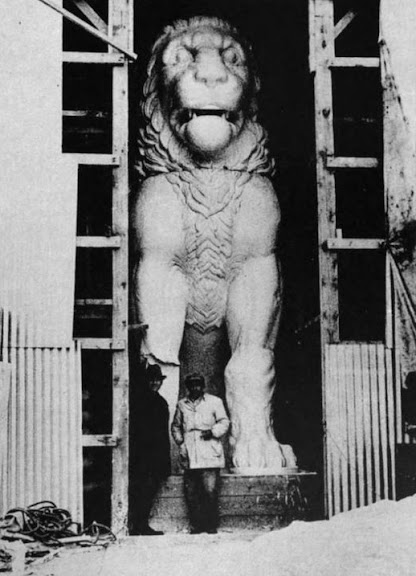
In ancient historian Plutarch’s histories of Alexander there is a story of a king who united all of Greece in 337 BC. This king dreamed that he placed a seal in the shape of a lion on the womb of his wife while she was pregnant. That ancient ruler's name was Philip II. His child was a son named Alexander III - better known to the world as Alexander The Great.
Did this lion once stand watch over an important site? If so, where was the site itself?
In 1977, archeologists thought they had an answer. A royal tomb was uncovered in the farming small town of Vergina (108 miles/175 km south of Amphipolis) by the Greek archaeologist Manolis Andronikos. This site is now known as The Great Tumulus or The Aegae.
At The Aegae, Andronikos found a series of his tombs that he theorized contained Philip II, his seventh wife
[1] Cleopatra Eurydice and their daughter Europa. This seems to be confirmed by damage to the remains that are consistent with historically recorded injuries sustained (and survived) by Philip in battle such as missing eye with the socket shattered around it.
[2]
All three of the deceased were Macedonian royalty. Each met tragic ends at the hands of their own friends and family. Yet several more members of the immediate royal family, including Alexander and his mother Olympias, remain missing.
Had the giant lion found at Amphipolis been moved 100 miles north from The Agae? Was it destroyed there by the Romans, who were infamous for razing cultures that had lost wars (like Carthage in Africa), or was it shattered by thieves who are now lost to history? Simple answers were not forthcoming for another 40 years...
At this point, remember Plutarch's exact description: "a lion on top of a pregnant woman's belly". Was there a secret here? Was Plutarch describing a public monument that stood in his own time of 75 AD just as The Viet Nam Memorial or Washington Monument stands today?
In 2012, on Kasta Hill in Amphipolis, near to where the fragments of the giant lion were first found, archeologists began digging directly into the hillside. Soon, they found a solid stone ring under the earth. As they uncovered more of the ring they revealed a wall that ran for hundreds of feet. And then... they found an entrance.
This turned out to be the first gate of an enormous tomb.
The total perimeter of the tomb was measured at 1600+ feet or nearly 500 meters round. The complex is enough to occupy four city blocks in Manhattan. It's original structure is theorized to be nearly seven stories tall (80 feet). Due to the early state of the excavation, no projections have been made on how deep the structure extends beneath the hillside.
It dwarfs Alexander the Great's father King Philip II's tomb at The Aegae which is 43 feet high, 360 feet in diameter. The Amphipolis complex is larger than all other royal families' and heroes' tombs found in the entire country to date.
In fact, this is the largest tomb ever discovered in Greece.
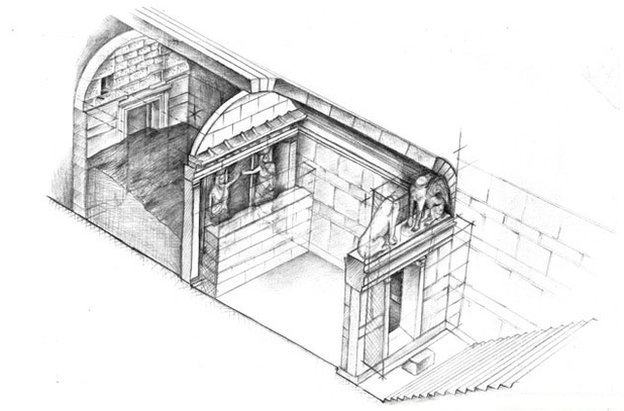 Artist rendering of the early state of excavation of the stone gates at the Amphipolis site.
It is important to put this discovery into a historical context. The historian Diodorus recorded that Alexander had given detailed written instructions to his trusted general Craterus some time before his death. Among these orders was the construction of a monumental tomb for his father Philip, "to match the greatest of the pyramids of Egypt".
The Amphipolis complex maybe the results of that order.
It is bordered on all sides by hewn limestone covered in marble. The first three entrances bear incredible resemblances to architecture found in Egypt and Athens including two perching stone sphinxes guarding the first doorway that bear an incredible resemblance to the Lion Gate at Mycenae
[3] in the far south of Greece built 1000 years prior to the Amphipolis first gate - in the 13th Century BC.
The early estimates propose the building's age to be around 2,300 years old. It was likely built in the 4th Century BC/circa 300 BC which places the structure's origin directly to the lifetime of Alexander the Great (June 356 - July 323BC).
II. King Philip, The League Of Corinth And Alexander
If the date of the Amphipolis complex's is accurate, the tombs were originally constructed in the very heart of the ancient Macedonian kingdom during the full height of it's power. From 360 to 300 BC, ancient Macedonia was a major world power led by the Argead Dynasty. During this time, Macedonia unified Greece after many wars among the city-states and tribes.
Under centralized leadership of The League of Corinth, founded in 337 BC by King Philip II
[2], Alexander's father, Macedonia was poised to make history by uniting the comparatively advanced technology of their people into a formidable national fighting force.
This did not happen overnight. Philip inherited a kingdom that was under Athenian control with a small army and in very real danger of destruction.
As a young man he was hostage in Thebes, where he had received extensive military training from a man who had defeated the Spartans, Pelopidas. Philip was also made aware of the Sacred Band Of Thebes, a small group of 300 elite warriors who led from the front in battle. These shock troops main function was to cripple the enemy by engaging and killing their best men and leaders in battle.
It was in Thebes he was taught important strategy and diplomacy - he would sorely need both in Macedonia.
In 364 BC, he was allowed to return home. According to the
research of Donald L. Wasson (Ancient/Medieval History Professor at Lincoln College) Philip became regent for his infant nephew Amyntas IV and:
"...completely reorganized Macedonia’s army. He increased its size from 10,000 to 24,000 and enlarged the cavalry from 600 to 3,500. This was no longer an army of citizen-warriors but one of professional soldiers. He created a corps of engineers to develop siege weaponry, namely towers and catapults. To give each man a sense of unity and solidarity, he provided uniforms and required an oath of allegiance to the king: each soldier would no longer be loyal to a particular town or province but faithful only to the king. Next, he restructured the traditional Greek phalanx, providing each individual unit with its own commander, thereby allowing for better communication. Philip changed the principal weaponry from the hoplite spear to the sarissa, an 18 to 20 feet pike; it had the advantage of reaching over the much shorter spears of the opposition. Besides the sarissa, a new helmet, and a redesigned shield, each man possessed a smaller double-edge sword, or xiphos, for close-in-hand fighting."
Soon, the Illyrians were no longer a threat. In 359 BC, Philip defeated an army of 3,000 Athenian troops thereby ridding his kingdom of foreign influence and control. From there he fought in a series of wars against city-states across Greece that secured Philip’s position as having the majority of Greece democracies under Macedonian sovereignty.
| "I swear by Zeus, Gaia, Helios, Poseidon and all the gods and goddesses. I will abide by the common peace and I will neither break the agreement with Philip, nor take up arms on land or sea, harming any of those abiding by the oaths. " |
| - The Oath Of The League Of Corinth, 337 BC |
The League Of Corinth was the first time in Greek history that each of the the major city-states (with the notable exception of Sparta
[4]) became part of a single, unified political entity. Philip well knew that the power that each kingdom possessed. His own father, Perdiccas III, fell in battle against a rival kingdom. Instead of holding onto his bitterness over his father's murder Philip found a way to harness the military power of Greece.
Together the united Greeks would become nearly unstoppable. The
pledge of the league was
never to make war on fellow Greeks or face total disaster.
The following year, in 336 BC, a twenty-year-old Alexander inherited his father's kingdom when Philip II was assassinated by a trusted bodyguard at his daughter Cleopatra's wedding reception.
There were many close to Alexander that would be killed before the conquests that he would become famous for would began. This list of unfortunate souls included his cousin Amyntas IV
[5] and his father's friend General Attalus, who had instigated an earlier exile for Alexander. They were executed along with the children of Attalus's sister Cleopatra Eurydice, Alexander's own and half-sister, Europa. There are also accounts that record that a half-brother named Caranus was also murdered.
The reason Alexander slew them was that Alexander himself was only half Macedonian. His his mother Olympias was from nearby Epirus and the kingdom of Molossia
[6]. Although still ethnically Greek Olmypias was a member a foreign royal family. Philip's fifth wife, Cleopatra Eurydice, was a Macedonian noblewoman. That fact made her children, all full-blooded Macedonian, more legitimate heirs than Alexander himself.
After Philip's death, Philip III (known as Arrhidaeus), Alexander's older half-brother, remained faithful to him. He made no claim to the throne, this was at least in part due to many reports of feeble-mindedness from the side-effects of a poison meant to kill him as a child.
Arrhidaeus, although dim, would fight alongside Alexander for the next 13 years.
The news of Philip's death and Alexander's newly made kingship sent many city-states into open revolt, including Thebes, Athens, Thessaly, and the Thracian tribes directly north of Macedon. Alexander responded by quickly mustering 3,000 Macedonian cavalry and rode south eventually arriving at Corinth. There, Alexander took the title of Hegemon ("leader") like Philip before him, and was appointed the commander for a new war against Persia.
Shortly afterwards, Alexander would lead his massive and newly unified Greek armies out to rule nearly all of late Iron Age civilization on Earth.
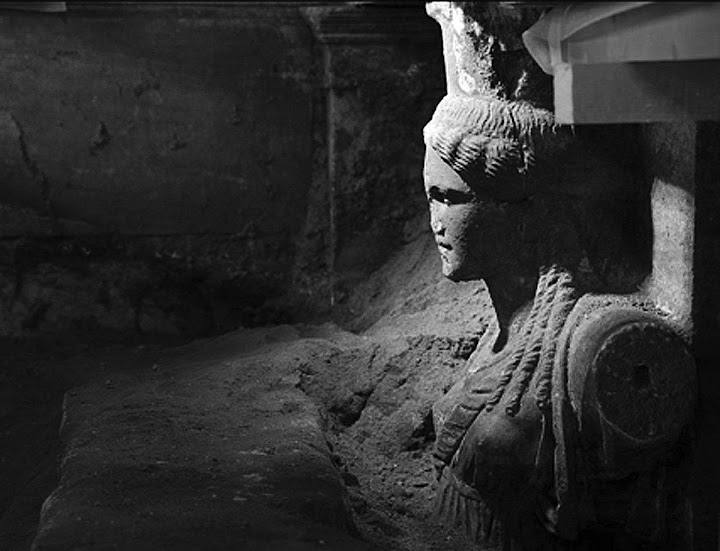 The second gate appears to be a variant of caryatid columns[7] in the shape of the a member of the Greek religious sect of Dionysus known as Klodones. Photo by author Andrew Chugg.
III. The Era Of Alexander The Great
The second gate appears to be a variant of caryatid columns[7] in the shape of the a member of the Greek religious sect of Dionysus known as Klodones. Photo by author Andrew Chugg.
III. The Era Of Alexander The Great
In 334 BC, Alexander the Great began his invasion of the Persian Empire. He subsequently defeated the longtime foes of all of Greece, the Persians and their ruler Darius III at Battle of Gaugamela near modern Erbil in northern Iraq. After Darius fled, Alexander destroyed the Persian capital, Persepolis, in 331 BC.
From Italy to Egypt, from Asia Minor to India the kingdom of Macedonia and the armies of Greece conquered kingdom after kingdom undefeated. After the battles were over, Alexander moved onward. Macedonia and Greece ruled their new territories by local governors (called satraps) following the tradition of the early colonial Greeks before him and setting the example for the Romans who would inherit the world left in Alexander and his followers' wake.
As Alexander led his Greek armies through Egypt, Persia, Iran and into India a massive tomb was being built in Macedonia. A structure like Amphipolis, built during an unprecedented era of conquest, could only have one purpose: to house the dead of the royal family of Alexander The Great.
But, Alexander would never be laid to rest in Macedonia.
After Alexander died of a sudden fever in Babylon near modern
Hilla in Iraq. After being laid to rest in a gold sarcophagus in Babylon, Alexander's body was sent to Macedonia but was seized in route to Greece. Then, it moved west from Greece to Egypt, first to Memphis and then to Alexandria.
The recent discovery of Amphipolis complex has given rise to speculation that it's original intent was to be the burial place of Alexander. This would fit with the original destination of Alexander's funeral procession, Macedonia.
As his body was fought over by his former allies and followers - the League Of Corinth shattered without a respected leader. The League would dissolve one year after Alexander's death and two wars, The Lamian Wars and the War of The Diadochi (322-275 BC) began among Alexander's chief generals. The power once harnessed by Philip fell apart and began to war with itself.
To make matters worse, Alexander had no obvious or legitimate heir at the time of his death. His son Alexander IV, by his Persian wife Roxane, was born after Alexander's death. The Argead Dynasty, from which both Philip and Alexander had both descended, would slide towards it's end when Alexander IV was poisoned by a duplicitous former ally of his father, Cassander, in order to appoint Alexander's feeble-minded brother, Philip III, in his place.
The kingdom of Macedonia and Greece herself would never rise from the heavy blow and leadership vacuum left after Alexander's sudden death.
Hundreds of years later, Romans would first come to admire Alexander at his Alexandrian tomb and then to desecrate his grave. Pompey, Julius Caesar and Augustus each visited Alexander's tomb in Alexandria. Augustus is rumored to have cut off Alexander's nose. Caligula was said to have taken Alexander's breastplate from the tomb for his own use. Around AD 200, Emperor Septimius Severus closed Alexander's tomb to the public. Severus's son and successor, Caracalla visited the tomb during his own reign. After this visit in 200AD, details on the fate of the tomb are lost.
The exact location of Alexander's tomb itself, today, is unknown. His father's tomb believed to have been found. There is no clear answer for who then is buried at Kasta Hill. The massive Amphipolis Complex is a mystery with several possible occupants that could be interred there.
| Macedonian Royalty Possibly Entombed At Amphipolis |
| Name | Birth-Death | Relationship To Alexander | Quick Biography |
| Amyntas III | ???–370 BC | Grandfather | Father of Philip II, Alexander II and Perdiccas. Founder of the unified Macedonian state. Expanded national trade with other city-states. |
| Eurycide I | 407-340? BC | Grandmother | First politically active "First Lady" of Macedonia. Became Queen of Macedonia after Amyntas and Perdicca's deaths. Married Ptolemy the killer of her eldest son, Alexander II, to protect her younger son Philip who would advance to the throne. |
| Alexander II | ???–369 BC | Great Uncle | A young and inexperienced king, Alexander II's armies were defeated by Thebes. His brother Philip was taken as a hostage. After his murder by the usurper, Ptolemy, his brother Perdiccas was made a child king. |
| Perdiccas III | ???–359 BC | Great Uncle | King who avenged his brother Alexander II's 369 BC murder at the hands of Ptolemy. Killed in battle with 4,000 of his men while repelling hostile tribes (Illyrians) in northern Macedonia. |
| Philip II | 382–336 BC | Father | First national leader of Greece - a cunning and powerful warrior. Founder of the League of Cornith. Assassinated by a bodyguard. Remains found at the Great Tulumus at Vergina. Remains consistant with ancient accounts of injuries. |
| Olympias | 375–316 BC | Mother | Fourth wife of Philip II and a daughter of an Epirian king. Ruthless supporter of Alexander. Very politically active even after the death of Philip and Alexander. Executed by Cassander. |
| Philip III | 359–317 BC | Half-Brother | Born to Philip II's third wife Philinna. Traveled in extensive military campigns with Alexander. Later, a figurehead appointed king after the death of Alexander III from 323–317 BC. Imprisoned and executed by Olympias in 317 BC. Diodorus claimed he was interred at the Great Tulumus. |
| Eurycide II | 359–317 BC | Sister-In-Law | Grand-daughter of Philip II's Illyrian wife Audata. Brought up as a warrior by her mother Cynane. Trained to hunt, ride and fight. Became Queen as the wife of Philip III. Confined with Philip III and executed by Olympias in 317 BC. Diodorus claimed she was interred at the Great Tulumus. |
| Cleopatra | 357–308 BC | Sister | Sister of Alexander and daughter of Philip and Olympias served as a religious head of state for her mother's people of Molossia and as an ambassador. Assasinated by order of a former general of Alexander - Antigone. |
| Thessalonike | 345 – 295 BC | Half-Sister | Daughter of King Philip II, half sister of Alexander the Great and eventually the wife of Cassander after he killed Olympia. Later she became Queen of Macedon and the mother of three sons, Philip, Antipater, and Alexander. |
| Roxane | 343–310 BC | Wife | Princess and Persian (Bactrian) wife of Alexander. Assassinated with her son Alexander IV by the order of Cassander. Possibly at The Great Tumulus in Vergina. |
| Alexander IV | 323–310 BC | Son | Son of Alexander the Great and Roxana. King in name only murdered at the age of 12 before claiming the throne of Macedon. Possibly at The Great Tumulus in Vergina. |
| Cleopatra Eurydice | 350?-336? BC | Step-mother | The seventh and final wife of Philip was a young Macedonian noblewoman. She bore a daughter Europa, and possibly a son named Caranus, to Philip II by doing so she became the enemy of Alexander's mother Olympias. Possibly at The Great Tumulus in Vergina. |
| Europa | 337?–336? BC | Half-sister | Daughter of Philip II. Executed on orders from Olympias. Possibly at The Great Tumulus in Vergina. |
| Caranus | 337?–336? BC | Half-brother | Son of Philip II. Executed on orders from Olympias. Possibly at The Great Tumulus in Vergina. |
Other possibilities include Antipater (397–319 BC) who served as a General and Regent of Macedonia during the reign of Philip and then also for Alexander. Later, Antipater became the guardian of Alexander IV and Philip III and co-ruler of Macedonia from 297-294 BC. There is also General Perdiccas (???-320 BC) who, after Alexander's death in 323 BC, became Regent of all Alexander's empire for two to three years. He was killed by his own officers at the front after disastrous battles were lost in Egypt in 320 BC.
The Diadochi war general that ruled Macedonia after Alexander was named Lysimachus (360 – 281 BC). He became a self-declared king in 306 BC and ruled until circa 281 BC. He definitely had the time and resources to devote to finishing the tomb and perhaps was even buried there himself.
Then, there is the treacherous Cassander (350–297 BC). Cassander was trained alongside Alexander by Aristotle as a boy. The duplicitous associate of Alexander was the son of Antipater and was sent in his father's place near Alexander, in Babylon, before Alexander fell ill. Cassander declared himself Regent of Macedonia in 317 BC. He captured and then executed Olympias the next year in 316 BC. Her body was reportedly left unburied for animals to consume. He also had Roxanne and Alexander IV confined at Amphipolis where they were also murdered.
Cassander remained Regent after Lysimachus came to power in 306 AD. He died of dropsy in 297 AD - particularly horrible way to die.
If these histories can be believed, then the strongest candidates for being buried at Amphipolis are Olympias, Roxanne and Alexander IV. Yet the tomb is so massive that it may well house other generations of Macedonian royalty as well.
The current team is busily excavating the site as of the publication of this article. In the near future, it's certain that more of the ancient story of Alexander The Great will be unearthed for all of the world to discover.
Notes:
[0] = In Acts Chapter 17 verse 1: "...they had passed through Amphipolis and Apollonia, they came to Thessalonica..."
[1] = Greeks practiced polygomy at this time.
[2] = Philip was no distant ruler just as his forebears before him. Philip lost his right eye at Methone in 355 BC and part of his right leg in battle against the Ardiaioi in modern Montenegro. His personal bravery must have inspired all those around him including Alexander.
[3] = The
Lion Gate is located in Mycenae in the far south of modern Greece.
[4] = Sparta was ambivalent towards Philip. In 349 BC, Philip sent a message to Sparta that read "If I win this war, you will be slaves forever." The Spartans' laconic reply was one word: "If". Philip II and Alexander both chose to leave Sparta alone. In 330 BC, Alexander's Regent, Antipater, sorely defeated Sparta.
[5] = Amyntas IV was the son of Alexander's avenging uncle Perdiccas.
[6] = The Molossians, the western neighbor of Macedonia, were known as tacticians and relentless fighters. Later, in the Third Macedonian War (171–168 BC), they would wage important but doomed battles against the Romans. They coined the term pyrrhic victory meaning a battle where all was lost for a stalemate.
[7] = Surviving examples of caryatids were found in Tralles in modern Aydin,Turkey dating to the early Roman period 1st Century BC. However, if these are confirmed as Klodones it means that the baskets on their heads held snakes which links them strongly to Olympias and her role as high priestess of Molossia.
References:
Wikipedia, Amphipolis
Wikipedia, Alexander The Great
Wikipedia, Philip II Of Macedon
Wikipedia, Wars Of The Diadachi
Greek Reporter, Is Alexander The Great's Mother In The Amphipolis Tombs?
MIT, Alexander



